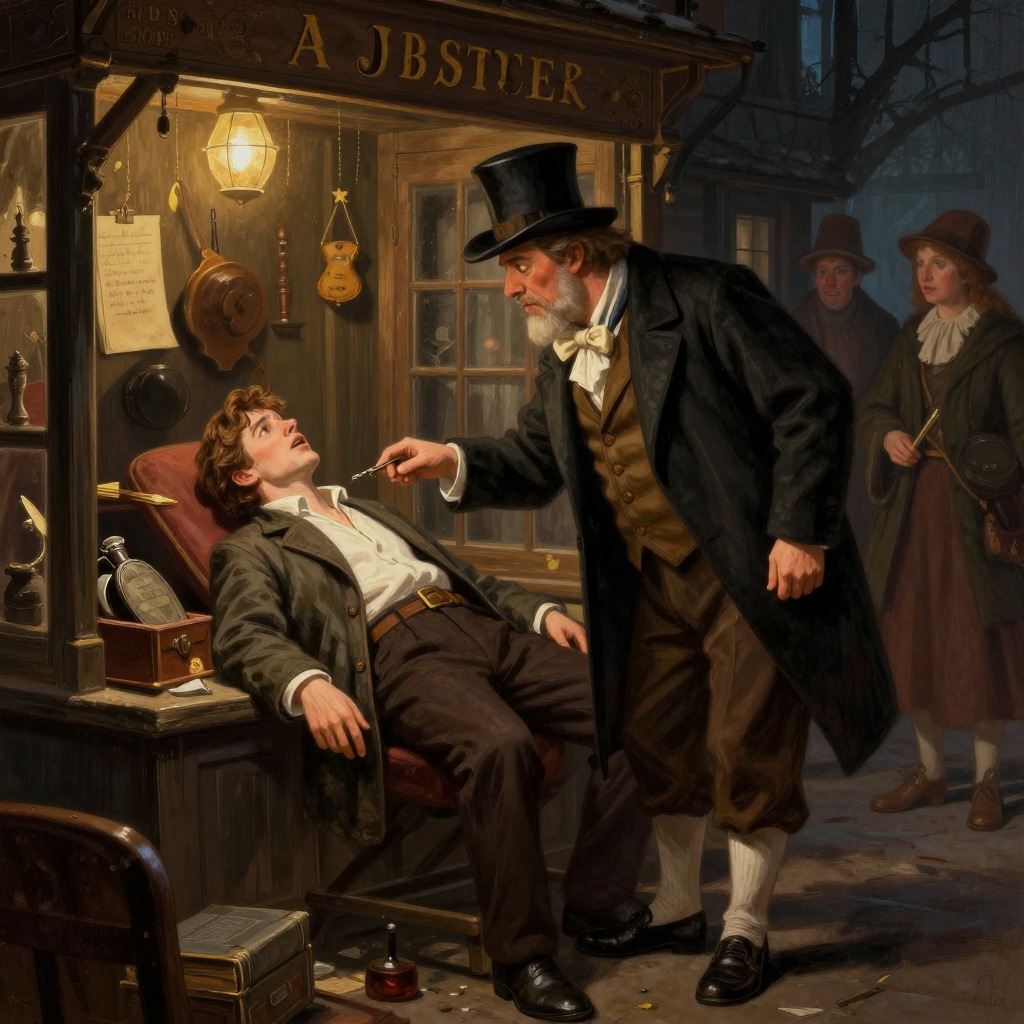
old Joe's shop
Old Joe's shop is a squalid, low-browed establishment in a foul and obscure part of London where stolen goods are fenced, serving as the setting for a chilling scene in which Scrooge's own death is foreshadowed through the callous disposal of his possessions.
Location and Appearance
Old Joe's shop is situated in an obscure part of the town, a quarter of bad repute that Scrooge has never penetrated before. The ways leading to it are foul and narrow; the shops and houses wretched; the people half naked, drunken, slipshod, ugly. Alleys and archways, like so many cesspools, disgorge their offences of smell, dirt, and life upon the straggling streets, and the whole quarter reeks with crime, filth, and misery. The shop itself is a low-browed, beetling structure below a pent-house roof, where iron, old rags, bottles, bones, and greasy offal are bought. Inside, heaps of rusty keys, nails, chains, hinges, files, scales, weights, and refuse iron of all kinds are piled upon the floor. Secrets that few would like to scrutinise are bred and hidden in mountains of unseemly rags, masses of corrupted fat, and sepulchres of bones. The proprietor, a grey-haired rascal nearly seventy years of age, sits among his wares by a charcoal stove made of old bricks, screened from the cold air by a frouzy curtaining of miscellaneous tatters hung upon a line, smoking his pipe in all the luxury of calm retirement.
The Scene of Plunder
Scrooge and the Ghost of Christmas Yet to Come come into the presence of Old Joe just as a woman with a heavy bundle slinks into the shop. She is closely followed by another woman similarly laden, and then by a man in faded black. After a brief period of blank astonishment, in which Old Joe joins them, they all three burst into a laugh. The first woman, a charwoman, declares that they have all met there without meaning it. Old Joe removes his pipe from his mouth and invites them into the parlour—the space behind the screen of rags—where he rakes the fire together with an old stair-rod and trims his smoky lamp with the stem of his pipe. The woman who has already spoken throws her bundle on the floor and sits down in a flaunting manner on a stool, crossing her elbows on her knees and looking with bold defiance at the other two. She argues that every person has a right to take care of themselves, and that the dead man is none the worse for the loss of a few things. The man in faded black produces his plunder first: a seal or two, a pencil-case, a pair of sleeve-buttons, and a brooch of no great value. Old Joe examines and appraises each item, chalking the sums he is disposed to give upon the wall, and adds them up into a total. Mrs. Dilber is next, with sheets and towels, a little wearing apparel, two old-fashioned silver tea-spoons, a pair of sugar-tongs, and a few boots. Her account is stated on the wall in the same manner. Old Joe remarks that he always gives too much to ladies, calling it a weakness that ruins him.
The Bed-Curtains and the Shirt
The first woman then undoes her bundle, and Old Joe, going down on his knees for greater convenience, drags out a large heavy roll of dark stuff. He asks if it is bed-curtains, and she confirms it, laughing and leaning forward on her crossed arms. She admits to having taken them down, rings and all, with the dead man lying there. Old Joe tells her she was born to make her fortune. She replies that she certainly will not hold her hand when she can get anything in it by reaching it out, for the sake of such a man as he was. She also produces his shirt, the best he had, which she took off again after somebody had been fool enough to put it on him for burial. She declares that if calico is not good enough for such a purpose, it is not good enough for anything. Old Joe, producing a flannel bag with money in it, tells out their several gains upon the ground. The woman laughs and says, "This is the end of it, you see! He frightened every one away from him when he was alive, to profit us when he was dead!"
Narrative Significance
Scrooge listens to this dialogue in horror, viewing the group with a detestation and disgust that could hardly have been greater had they been obscene demons marketing the corpse itself. He realizes that the case of this unhappy man might be his own, and that his life tends that way now. The scene at Old Joe's shop thus serves as a crucial turning point in Scrooge's moral awakening, forcing him to confront the ultimate consequence of his avarice and isolation: a death so unloved that his own servants strip his corpse for profit. The shop itself, a den of infamy in the city's most degraded quarter, becomes the physical embodiment of the spiritual degradation that awaits Scrooge if he does not change his ways.